my online space for all learning & discovery

Mind, Movement, Money, and Markets

  • all opinions here are my own

    Let’s Have a Conversation about Friendship

    what to expect: my thoughts on friendship as a 23 year old, with a lot of stuff still left to learn but with some life experience and a bit of research

    If I were an older sister, I would have a lot to say about friendship. These are my thoughts.

    But before I begin, I wanted to make one quick point. My writing on friendship is not intending to convince you of one decision or truth. My aim is to offer some research and reflection that I had on what friendship is and what I have learned so far. The questions I ask myself, and rabbit holes I took in this process, brought me to so many different conclusions. This writing can spark thoughts you might have, or opposing opinions, and that is the beauty of the discussion.

    With that said, let’s chat 🙂

    What does friendship mean to you?

    I would be so lost without my friends. All my friends have pushed me in one way or the other. Some friendships have grown me in the direction of success. They have helped me learn about myself, through vulnerable conversations of my insecurities and my upbringing. They have allowed me room to talk about my goals in life, and pushed me to achieve them. They have shown up, when I needed to be celebrated, and cried with me when it felt like I might just fall apart. I am so thankful for the many people who have filled this role in different chapters in my life.

    Even my harder or harsher friendships have taught me something about myself. Whether I had to end a friendship or someone stopped wanting to be friends with me, the conflict made me the person I am today and how I choose to show up in my relationships. My friend “break-ups” allowed for moments of reflection and contemplation on why it might have happened. Although it can take weeks, months, or even years to understand, they are an unavoidable part of life. You gain the understanding of who you are and who you are not; who “your people” are and who they are not.

    Friendship and community, closeness to those around you, and mutual support make humans better off, and this is studied.

    Studies show time and time again that our relationships are everything.

    Robert Waldinger, an American psychiatrist at Harvard Medical School led one of the longest-running studies of adult life, which has ran for 75 years with the participation of 724 men. In a TED talk he gave he claimed the study determined “good, close relationships are good for our health and well-being” (Waldinger, 2016). It showed that social connections are good for us and our health. It is not just the number of friends we have or how strong one’s marriage is, but the quality of our many relationships.

    Julianne Holt-Lunstad, wrote “Social connection as a critical factor for mental and physical health: evidence, trends, challenges, and further implications” in the World of Psychiatry in 2024. The article discussed how social connectivity is not only acknowledged to be a fundamental human need, that is linked to higher well-being, safety, resilience and prosperity, and longer life spans but also that the availability and diversity of relationships and networks are critical (Holt-Lunstad 2024). There is a strong association of social isolation with depression from youth to adult, and can have worsening effects overtime (Holt-Lunstad 2024). We expect this, however, the article includes that social engagement and social networks are associated with better cognitive function, and positive health outcomes.

    In terms of happiness, some believe they will achieve it after reaching a certain goal or material wealth. However, money has only been proven to affect happiness up to a certain point, as we adjust our expectations to desire more. Some researchers have even gone as far as studying the exact thresh-hold of income people reach before this marginal effect on happiness disappears. Research from Purdue University studied data from more than 1.7 million people from 164 countries, and determined that once the thresh-hold was reached, further increases in income actually was associated with reduced life satisfaction and lower levels of well-being. This hedonic treadmill of desire for material wealth, further solidifies just how important our relationships with ourselves and to others.

    Relationships are so impactful through the chapters of life, to enjoy life’s pleasures.

    One of my favorite sections from the book “The Subtle Art of Not Giving A F*ck“, by Mark Manson:

    “The ticket to emotional health, like that to physical health, comes from eating your veggies—that is, accepting the bland and mundane truths of life: truths such as ‘Your actions actually don’t matter that much in the grand scheme of things’ and ‘The vast majority of your life will be boring and not noteworthy, and that’s okay.’ This vegetable course will taste bad at first. Very bad. You will avoid accepting it. But once ingested, your body will wake up feeling more potent and more alive. After all, that constant pressure to be something amazing, to be the next big thing, will be lifted off your back. The stress and anxiety of always feeling inadequate and constantly needing to prove yourself will dissipate. And the knowledge and acceptance of your own mundane existence will actually free you to accomplish what you truly wish to accomplish, without judgment or lofty expectations. You will have a growing appreciation for life’s basic experiences: the pleasures of simple friendship, creating something, helping a person in need, reading a good book, laughing with some you care about. Sounds boring doesn’t it? That’s because these things are ordinary. But maybe they’re ordinary for a reason: because they are actually what matters” (30).

    The Potential Downside of a Friend Group

    There is harm in focusing too greatly on creating a “friend group.” People romanticize having friend groups heavily as you grow up. It is human nature to belong and to form groups. It is visibly desirable. It is aesthetic. It is rewarding to feel well connected and supported. You can spend years of your childhood seeking a cohesive group to spend time with, seeking more friends, seeking quantity.

    But what does this quantity do to the quality of friend you can be, and show up as. Are you truly focused on the appearance of friends, or fostering close relationships? I made mistakes myself in that pursuit, and in the more recent years was better able to understand the difference.

    Many books I have read explore the themes of the desire to belong and insecurity of loneliness. They offer more extreme examples of how group thinking and group conformity is dangerous.

    The three books I included on this topic (of many) :

    The Secret History

    A classic novel that talks of a tight knit group of elite Dartmouth students that shows how the desire to belong is a destructive force.

    Brutes

    A dark story of a group of teenagers in Florida that discusses obsession, and the “manic joys of girl hood. Brutes is a novel about the seemingly unbreakable bonds in the ‘we’ of young friendship’” (Catapult Book Review).

    The Girls

    A story told from a middle-aged women, Evie, who looks back on her adolescence as she came in contact with a sect/cult, and shows the power of loneliness and identity. The book is loosely inspired by the Manson Family.

    The books offer hyperbolic portrayals of feelings and obstacles faced in adolescence. As girls and boys find friends that have similar interests or due to shared activities, they fall into many different groups. The classic high school jocks, nerds, and musicians story we have seen in almost every coming-of-age movie. While the over dramatized grouping in movies may not be how it plays out, we all experienced the grouping of youth. This is a puzzle that might not be solved for some throughout all of K-12. In college, the process “starts over,” with people who are more set in their interests and selves are then forced into a new environment of new people.

    Young people feel an intense desire to belong. There are so many outcomes and mistakes that can be made in the process of finding friends. The first is exclusion. People exclude others for a multitude of reasons. Exclusion can be a false form of status, which is arguably rooted in self-esteem issues. Exclusion creates a greater sense of group-identity, of “us” versus “them,” and it establishes a power over the people excluded. Intentional exclusion can represent setting a boundary over someone who does not deserve an invitation or to be a part of your life. But early on, exclusion can be rooted in less of a productive or kind way.

    Beyond this, other friendship issues can arise from social climbing, the need to switch your friends based on their “hierarchy” or “status” in an environment (college, high-school, sports teams, etc.). This is based on external factors of popularity, and usually is done by someone who truly is seeking friends that look the best to them. These are two examples of natural negative outcomes of insecurity and immaturity, that stems from this idea of friend groups.

    While these books discuss the less relatable or applicable ways that friend groups fall apart, they offer insight into group dynamics and real life behavior. The beauty in reading fictional stories, is you’re able to really dive into another person’s life, and then you are able to take that with you in your own experiences. Once you see the negatives of group think and identity as a group, you can see how that might be impacting your own life.

    *my article on reading and how it can impact empathy
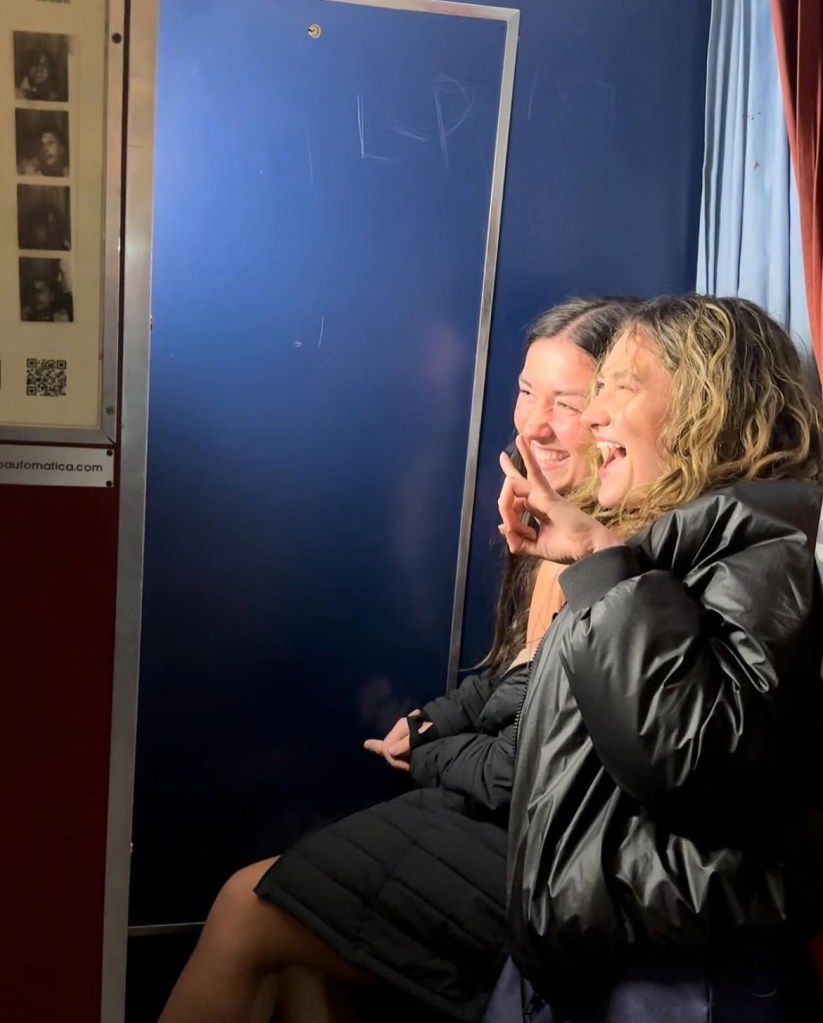
    Friendship is a beautiful thing that comes from shared experiences, vulnerable conversations, and seeing other people for their most beautiful qualities while understanding their fundamental flaws. Friendship is something that has to be nurtured with intention, and I just think friend groups can go against that entirely.

    This can harm you in covert ways, such as expending energy on friendships without shared values or allowing people into your life that may not be deserving of your time. There have been a few times where I was in a group with someone who I personally did not get along with and thought to myself, “have I ever really had a conversation with just them?”

    Even from a practical perspective, group chats and group plans cause a lot of harm. You become out of control in terms of who you see and when, you don’t intentionally set aside time. The group plans become the norm, and you can become obligated and entitled. You just show up to the event without much intention behind it. This can create passive or complacent friendships, where you cannot sit and reflect on how these friendships might be shaping you. You may even find yourself realizing that you don’t even know some of the other people in that group, and you just see and interact with them in a group setting.

    One piece of advice I heard was to notice how you feel after seeing a friend. How do you feel physically: do you feel drained? do you feel energized? How do you feel mentally: do you feel uplifted? Do you feel inspired or do you feel anxious? Notice what friends bring out the best version of yourself or push your best traits, and what friendships might make you focus on other traits that you might not like.

    On the note of feeling entitled to plans: The concept of entitlement in a friend group is when someone believes they have a right over these friends and plans. They may accuse other friends of not including them on purpose, or demand more from their friends. While in some cases this may be the case, telling your friends that you deserve to be a part of their plans is another form of entitlement. If your friend genuinely wants to spend time with you, they will not exclude you, but once you enforce that idea on them, it may. Being in a friend group should not reserve or correspond with getting to know all plans and all things (in my opinion of course). There are exceptions to this, may I add briefly, that it is understandable to be upset if these plans were a) talked about with the friend beforehand or b) on a date you were already intending to see said friend. But again, this is all based on context.

    People who felt excluded or entitled to plans may shame or make the friends feel bad for them. But that can build resentment and unease when making plans in general.

    Another manifestation is jealousy towards the closeness of others. While this is typical if you are less secure, immature, or have another unresolved issue, it causes you to act a way you probably don’t want to. I have been guilty of all these things, and I know many people have too. It is a part of growing up, and it something I wish I had reflected on sooner. You can’t expect to always be introspective and aware, it is something that comes with age, journaling, therapy, and vulnerable conversations.

    Groups can further create a sense of shared identity that can start to blur your own interests. In my experience, I found myself leaning more towards interests that I didn’t particularly want to but it allowed me to feel closer to my friends. This is not always a negative thing, but always relying on group plans might make you lose sight of what you truly enjoy.

    As you go through time, without reflecting on how the time spent with others makes you feel, you can become complacent. Friend groups can be healthy, successful, and so so supportive. The importance is navigating them intentionally and fostering individual relationships.

    The Pressure of Constant Connection

    Friendship is changing due to technology. This is an obvious truth, but how should we know as young adults what the right levels of connection are? What are the expectations on long distance friends, and how do I show up for my friends virtually?

    These questions are unanswered for me. We now maintain more connections than our parents ever had to. This can be attributed to access to constant communication. Social media is a form of social currency, with likes, comments, direct messages, or responding to stories. Our phones further create new technologies, such as the voice memo, that allow us to pass audio messages when we cannot reach each other on the phone. This is objectively a good thing; we are able to reach our friends like never before.

    But does that mean that it can have negative consequences at the same time?

    I believe the feeling of constant connection and the feeling of immediate reach of our friends can also be a limiting force. As we enter new chapters of life, or move to new places, we can fill our time with our digital connections. People no longer have to start fresh, or venture out to make friends. They have friends!

    Is that a natural human response? Are we supposed to stay anchored to our same friends like this? I would argue, no. I feel so thankful to be able to contact my friends who don’t live in the same city as me, but I also strive to create new relationships in my new post-grad city. I believe it is a natural process that continues to teach me about the people that matter to me most, my identity, and my interests in relation to others.

    Furthermore, connectivity with friends and family is a double edged sword. For emergencies, yes being able to reach our friends within minutes is great. It comes back to obligation, should we always be reachable?

    I personally feel a sense of anxiety that I am not doing enough to stay connected to my hometown and college friends. I will feel like I haven’t spoken to them enough, or don’t know what is going on in their lives. But I feel as though this is unnatural. In reality, I haven’t lived close to some of my my friends for over 4 years. Playing phone tag or never quite aligning a time to speak over text can cause both of you to feel removed from each-other’s lives.

    I don’t believe there is a right or wrong answer. It is just something to think about. Can conversations over text or social media really be equated to the closeness or intimacy of an in-person conversation?

    A Recent Trend: “Protecting Your Peace”

    One thing I have seen on social media, with the rise of health and wellness culture is the idea of “protecting your peace.” A lot of times, this is within the context of staying in on a weekend night, choosing to spend time alone or “choosing you.”

    While I love that health and wellness is on the forefront of our generation (Gen Z), there is a difference in protecting your peace and just not being a great friend. There is an influx of sentiment around choosing to stay in and spending more time alone. This is not an inherently bad thing, because everyone has moments where they really do need to prioritize themselves. Spending time alone is also not a bad thing, it is just the context around not showing up for your friend or putting your friends needs above your own at times. There will be moments where you need to go out, or you need to spend time with a friend, because showing up matters!

    You should go out with your friends on times when you might not want to, especially if you committed to it previously. Regularly flaking on your friends, even if it is for your health and well-being, is just being a bad friend. I think a good follow-up to a cancellation of plans is making effort to plan something else. Telling someone you can’t make something, but providing them the next available time you are free makes a big difference.

    Ending on a Good Note

    My intention is to not share right from wrong but to offer a perspective on how your decisions on friendship can be approached.  I want to offer my experience to help you feel empowered to make your own decisions and draw your own conclusions. Today, a lot of people will look to social media to see other’s perspectives on situations, or will see other’s successful or unsuccessful outcomes. If we seek opinions or validation of our own decisions, we discredit our own faith in ourselves and our own ability to make decisions. I had so many thoughts on this topic I thought it could be a great space for a conversation on friendship. Online, there are countless videos and opinions that will tell you what decisions you can make. But I do believe that truly no one will understand your own circumstance or relationships.

    Friends have gotten me through every chapter of my life. I am thankful for every friend I have had, even the ones I have lost.

    works referenced

    Holt-Lunstad, J. (2024). Social connection as a critical factor for mental and physical health: Evidence, trends, challenges, and future implications. World Psychiatry, 23(3), 312–332. https://doi.org/10.1002/wps.21224

    Jebb, A. T., Tay, L., Diener, E., & Oishi, S. (2018). Happiness, income satiation and turning points around the world. Nature Human Behaviour, 2(1), 33–38. https://doi.org/10.1038/s41562-017-0277-0

    TED. (2016, January 25). What makes a good life? Lessons from the longest study on happiness [Video]. YouTube. https://www.youtube.com/watch?v=8KkKuTCFvzI
  • all opinions here are my own

    The Oil Industry Explained

    what to expect: a basic explanation of the oil market in the context of Venezuela

    In the beginning of January, we saw the president of Venezuela and his wife captured and brought to the US on drug trafficking.

    Trump announced that US oil companies will rebuild the oil industry in Venezuela. In Trump’s words at a news conference “they were pumping almost nothing by comparison to what they could have been pumping” and “we are going to have our very large United States oil companies, the biggest anywhere in the world, go in, spend billions of dollars, fix the badly broken infrastructure, the oil infrastructure.”

    So what does this mean?

    According to the U.S. Energy Information Administration, Venezuela has 303 billion barrels of oil reserves, the largest oil reserve in the world (2024). Chevron is the only U.S. oil company with active operations there. Trump said the US oil companies will pay directly for the rebuilding of crude infrastructure, and will be reimbursed (Kimball 2026).

    The History

    In 1976, Venezuela nationalized its oil industry. This resulted in the president at the time, Hugo Chavez, seizing assets from International companies to create state-owned Petróleo de Venezuela S.A. (PDVSA). Exxon and Conoco have billions of dollars in outstanding claims against Caracas from these moves (Kimball 2026). In Trump’s words it was one of the “largest thefts of American property.” It is alleged that Conoco is owed $10 billion and Exxon is owed around $2 billion (Kimball 2026).

    In the 1990s Venezuela produced 3.5 million barrels per day, with production today being at 800,000 barrels (Kimball 2026).

    In “The United States’ Aspirations for Venezuela’s Oil” on the Daily, they discuss the subject of the oil being “rightfully” owed to the US, the sentiment that is seen throughout US media and the Trump administration. The expert, Anatoly Kurmanaev, dove into the oil industry in Venezuela, which took off in the 1920s. When the oil industry boomed in Venezuela, American Oil workers moved for work, creating a culture that blended America and Venezuela. “American” towns began to emerge, that grew into cities that resembled American way of life. Alongside this, America invested capital, as Venezuela became the largest exporter in the world. This oil wealth built up the country’s infrastructure. With the presence of major corporations, citizens began to realize how much of their countries profit went to foreign entities.

    This drove the rise of “resource nationalism.” This concept was that natural resources belong to the citizens of the state, and the wealth belongs to them. Leaders ran for office appealing to voters with this idea.

    OPEC was then formed, in large part to leaders in Venezuela, an entity that provides co-operation and alignment of the largest players in oil. The Organization of the Petroleum Exporting Countries (OPEC) involve the largest oil-producing and oil-dependent countries, including Iran, Iraq, Kuwait, Saudi Arabia, and Venezuela when it began in 1960. Today, it has 12 countries. The idea behind OPEC was agreeing on the amount of barrels produced, which would impact supply. This supply allowed for somewhat control over prices, which would impact the countries profit.

    After this first wave of nationalism, in the 80s, the price of a barrel of oil went down. Venezuela’s economy was so dependent on oil, that this caused the economy to struggle. After this was a period of “oil opening” policy. This welcomed foreign investment into the country, and reversed nationalization efforts.

    However, this effort was short lived. In 1999, Hugo Chavez became president of Venezuela. In 2002, Chavez replaced oil executives with political allies with limited experience. This resulted in employees being dismissed after strikes broke out and the oil production dropping. Chavez worked against the “oil opening,” and forced companies to give up control of the projects.

    Following Chavez’s death, in 2014, Venezuela entered a “pro-longed period of economic decline” (Kurmanaev 2026). Delcy Rodriguez, the now interim president, was tasked with turning the economy around. She was the minister of economy and finance, and has had significant improvements since she began.

    In 2022, Biden’s administration issued a license that allowed for a joint venture between Chevron and the PDVSA for oil. Later, in July 2025, the current administration granted a restricted license, allowing production but banning proceeds from going to Maduro’s government.

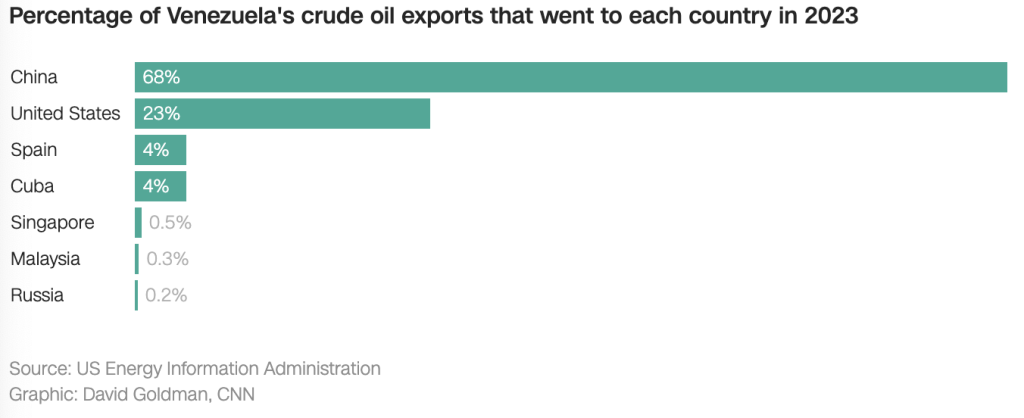
    Below is a graph provided in David Goldman’s for CNN:

    China and Russia both participate in Venezuela’s oil exchange. In November 2025, there was a 15-year extension of a joint-venture with Russian-linked companies with operations there (Kimball 2026).

    The Market

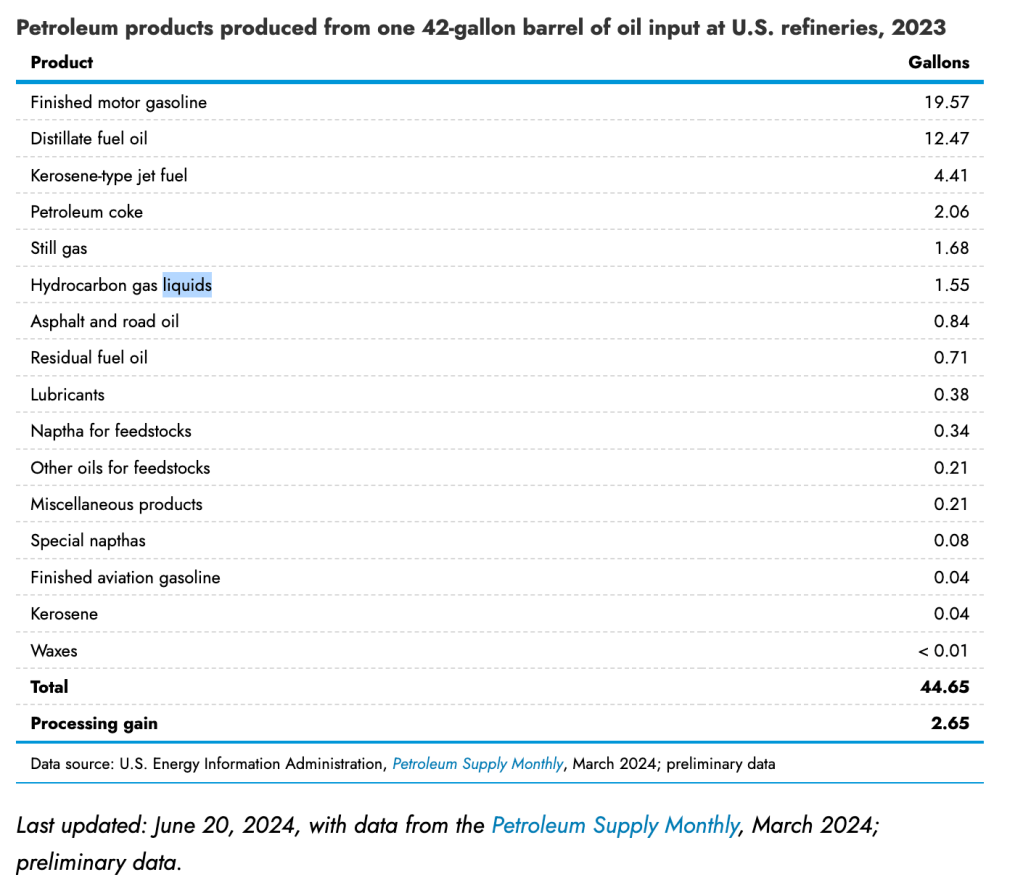
    Oil is a commodity, often time you hear in business the “commodities market.” These are raw materials used to create products. Oil is used for many products which are created at different points in the refining process. Refining, is the breaking down of crude oil into various parts, which can then be used for products. Oil is used in gas that fuels our vehicles and heats homes and businesses. From the U.S. Energy Information Administration, in 2023, the US consumed on average 20.25 million barrels of petroleum per day (petroleum is a term that encompasses both crude oil and petroleum products). Most crude oil is produced or imported and then refined into petroleum products, gasoline, diesel, heating oil, and jet fuel.

    source

    Commodity markets are more than just trading resources. The market has contracts for trading, which created commodity futures exchanges. This allows commodity producers to hedge, or avoid, risk that comes from price fluctuations (risk). This risk from price changes, gets sold or passed to others in the economy. The asset class has evolved over time, and has mutual funds, ETFs, notes, and other ways to participate in the market.

    The current oil market has growing supply and weak demand. The larger economy has struggled with inflation and affordability, contributing to the fallen demand. By making Venezuela a bigger supply of oil, western oil companies could produce and use more. This aligns with the priorities of US businesses, specifically, big tech in the United States. With the massive energy demanded for AI infrastructure, people are scratching their heads over how to fuel these projects.

    Lower prices however disincentivize US oil companies from further production. In the world of economics, incentives are important to understand human (and corporate) behavior. What will incentivize US companies to start doing business in Venezuela again? According to CNN, the PDVSA (Venezuelan state-owned oil and natural gas company), says its pipelines have not been updated in 50 years (Goldman 2026). With an estimated price tag of $58 billion to return to past levels of production (Goldman 2026).

    As of Sunday January 11th, the price of oil is $59.12 per barrel. The price went above $60 a barrel when oil was siezed from the US, but then fell to $57.

    There is a current embargo, an official ban on trade or commercial activity with Venezuela. With talks of the first oil tanker coming to the United States in the coming weeks.

    The Oil

    The reserves are located in the Orinoco belt and are heavy crude oil that requires a lot of effort to use. One analogy discussed by Mark Zandi and Ed Elson “What Venezuela’s Regime Change Means for Oil”, was how oil has a spectrum of good to bad. If the good oil was champage, the bad was like coffee grounds. The crude oil would be described on the end of the spectrum like coffee grounds, that requires companies to extract, refine, and then use the oil through technical and advanced processes. Before this happens, there are negotiations to how US companies will approach re-entering the oil businesses there.

    The actual production is 0.8% of global crude production, at 1 million barrels a day (Goldman 2026). Before the current regime, as previously discussed this is a decline from when the country produced 3.5 million barrels a day. During this decline, the country saw international sanctions and an economic crisis that furthered its impact, on top of the lack of attention and investment.

    The United States is the largest oil producer. The oil produced in the US is important for gasoline. The heavy oil that is Venezuela has is used for diesel, asphalt, and fuels for factories (Goldman 2026). Diesel has been in “tight supply around the world” largely because of previous sanctions on Venezuelan oil (Goldman 2026).

    Looking Forward

    Before moving operations back to the country, it is expected that U.S. producers will seek to recover claims of the oil seized back in the 1990s. Chevron is poised for growth, with a resource base already there and joint ventures with the PDVSA. Being apart of 23% of the nation’s output.

    Investors sent the shares of Chevron, Exxon Mobil, and ConocoPhillips up, the three largest U.S. oil companies. The market was bullish on the news, also with companies that help service oil, Slb, Halliburton, and Baker Hughers shares ending up.

    The turmoil of the country could prevent any production, however the current administration is pushing US oil companies to participate. In the newsletter sent out from the New York Times on January 9th, Trump sat down with oil executives and said that he expects at least $100 billion to rebuilt the oil infrastructure in Venezuela. Executives expressed their reservations and uncertainty with the stability of the nation, even using the term “uninvestable”. The interim government are working to establish diplomacy with the United States and potentially open back up the US embassy there.

    In Venezuela, there are armed groups, political loyalists to Maduro, as well as political adversaries. Rodriguez is under pressure of maintaining a stable rule of law and ensuring political stability. If this were to be achieved, the United States would gain a major source of oil production, driving oil prices down. This would potentially lower the cost of products, addressing the affordability crisis in the US. However like previously mentioned, this lies on the incentives of major corporation to participate. The production furthers Americas geopolitical power with oil, specifically with China and Russia.

    It will be interesting on what is to come with Venezuela and the oil market.

    source

    Works Cited

    While the media is in a frenzy, there have been some great discussions on the Daily Show done by Michael Barbaro and Prof G Markets with Ed Elson. This sparked my interest and inspired this work.

    Kurmanaev A., & Abrams, R. (Hosts). (2026, January 13). The United States’ Aspirations for Venezuela’s Oil [Audio podcast episode]. The Daily. Spotify. https://open.spotify.com/episode/632QIC2DC1KxoWSFyuelnO

    Goldman, D. (2026, January 3). Trump says U.S. is taking control of Venezuela’s oil reserves and recruiting American companies to refurbish its oil industry. CNN Business. https://www.cnn.com/2026/01/03/business/oil-gas-venezuela-maduro

    Kimball, S. (2026, Jan 3). Trump says U.S. oil companies will invest billions of dollars in Venezuela after Maduro’s overthrow. CNBC. https://www.cnbc.com/2026/01/03/trump-venezuela-oil.html

    Galloway, S., & Elson, E. (Hosts). (2026, January 6). What Venezuela’s regime change means for oil [Audio podcast episode]. In Prof G Markets. Prof G Media. https://open.spotify.com/episode/2ojrVz6ZkcJ4nMfk3WicLa

    McDaniel, W. (2025, June 11). Everyday products & uses [Fact sheet]. Colorado Oil & Gas Association. https://www.coga.org/factsheets/everyday-products-uses

    PIMCO. (n.d.). Understanding commodities. PIMCO. Retrieved January 13, 2026, from https://www.pimco.com/us/en/resources/education/understanding-commodities

    U.S. Energy Information Administration. (2024, February 8). Country analysis brief: Venezuela (PDF). U.S. Department of Energy. https://www.eia.gov/international/content/analysis/countries_long/Venezuela/pdf/venezuela_2024.pdf

    U.S. Energy Information Administration. (2024, October 9). How much oil is consumed in the United States? U.S. Energy Information Administration. https://www.eia.gov/tools/faqs/faq.php?id=33&t=6

    U.S. Energy Information Administration. (2024, June 20). Refining crude oil — Inputs and outputs. U.S. Energy Information Administration. https://www.eia.gov/energyexplained/oil-and-petroleum-products/refining-crude-oil-inputs-and-outputs.php

    The New York Times. (2026, January 9). Live Updates: Trump meets with oil executives at White House; Venezuela projects unity after Maduro’s ouster [Live blog]. The New York Times. Retrieved January 13, 2026, from https://archive.vn/2026.01.09-224841/https://www.nytimes.com/live/2026/01/09/world/venezuela-trump-us?campaign_id=57&emc=edit_ne_20260109&instance_id=169076&nl=the-evening&regi_id=175283365&segment_id=213443&user_id=cbf90162b8a099514002781c865b5201

  • all opinions here are my own

    A Guide To Goal Setting in the New Year

    what to expect: what i recommend to achieve new years resolutions in 2026

    December is a time for celebrating the Holiday’s with family and friends. It can be a deep breath after a year of hard work. This past year was a stressful one that took a lot of strength and resilience. While people are out of office, or on a much needed break between semesters of school, it is the perfect time to set intentions for the year to come.

    I appreciate the time of year to refresh my goals and vision, spending time reflecting and imagining.

    Reflection: The Key to Goal Setting

    The first step before I set goals for the New Year is having an open and honest reflection of my current state. It allows you to gain insight to move forward, appreciating where you are while also recognizing areas that you have room to grow.

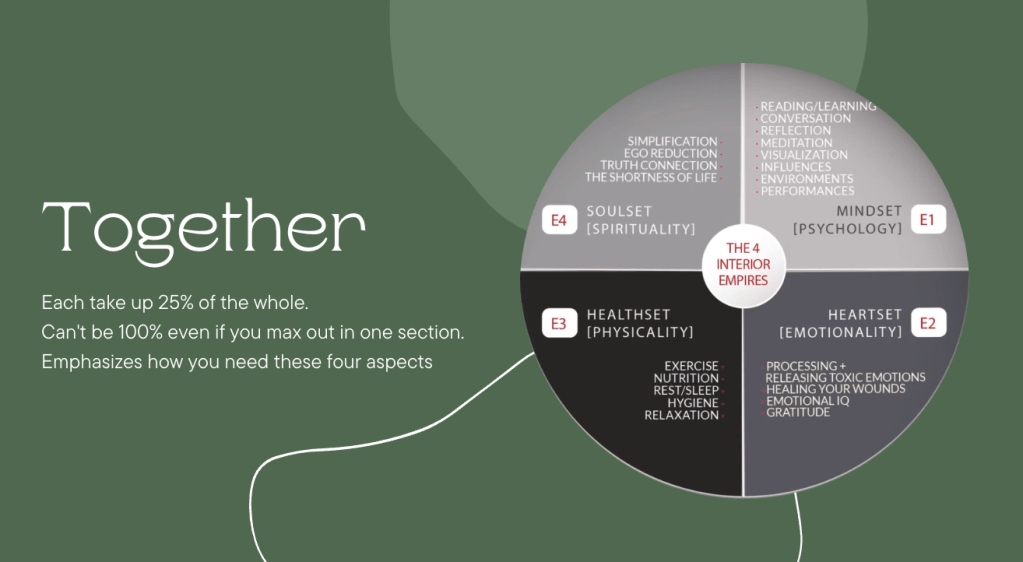
    One journaling exercise is the four interior empires. The idea, originally introduced in “The 5 AM Club” by Robin Sharma, is your mindset, healthset, heartset, and soulset.

    The mindset focuses on personal development, learning, and growth. This is things like daily journaling, podcasts, writing, and other creative outlets.

    The healthset is all things physical. Working out, movement in general, sleep, hygiene and what we eat or drink.

    Our heartset is emotional well-being and relationships. The connections we have to other people and are ability to process and handle emotions.

    Lastly, our soulset is our belief in ourselves and purpose. This can be our value, outside of our external appearence or material items.

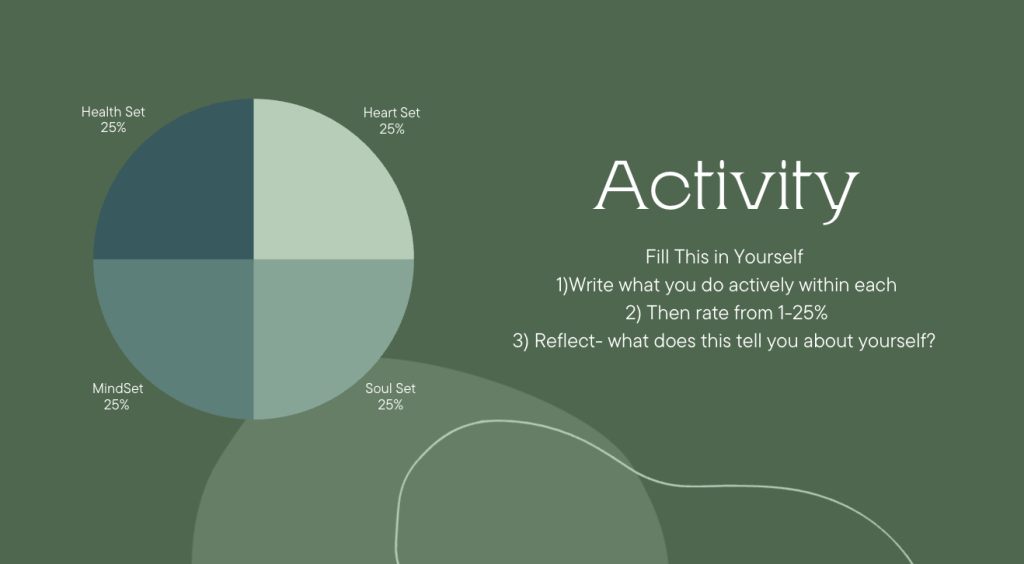
    These four quadrants make up ourselves. Draw a circle and split it into these four quadrants. Anything written inside the circle are things you do that focus on each empire. Anything outside of the circle is things you don’t do, or things that may have a negative impact on that area.

    picture information from here

    After filling in your sheet, try to rate from 0-25% for each quadrant. These four quadrants make up your whole 100% self. It is important to note that you cannot fulfill yourself with just one. While you may be fulfilled your fitness goals, hitting the gym, eating clean, and doing all the right things, you cannot reach 100%. You still have 75% of yourself. It is a reflection that can call attention to areas that you may be neglecting. This acts as a great eagle eye view of where you are thriving and where you can grow.

    Envision Your Future Self

    The next exercise you can do alongside the four interior empires is envisioning a future version of yourself. What values do they possess? How do they spend their time ? What do they have?

    I started by writing a list of things that my future self would say. Here are some examples: I prioritize my health, I eat whole foods, and I train consistently, not obsessively. I am a lifelong student. I make service a priority. I don’t need to drink to have fun, I have genuine relationships, and I say no when I need to re-charge. I have a unique and comfy space and I spend money on experiences more than things. By envisioning my future self, I have created a list of my values. Now try to connect these values and future state with actionable goals.

    Our goals can be long-term, medium-term, or short-term. With the reflection we have just completed, we are better able to set the standard for 2026.*

    *Set the Standard, a phrase I got directly from Nick Bare.

    Forward Think, Backwards Plan

    Then plan backwards. By imagining your end goal, you can then set up your week or months to create actionable steps to get there. What are the incremental changes that will get you there.

    If you are in the process of trying to better yourself, I highly recommend reading James Clear Atomic Habits. The book acts as a guide through bettering yourself every single day. In his words “small habits, when repeated consistently, lead to remarkable results.” A big downfall to New Year’s Resolutions, is that people set goals that are extreme and unsustainable. This leads to an “all-or-nothing mindset,” that when you make one small mistake or miss one day, that suddenly it is not worth it at all.

    The little things, really are the big things. Creating a set of daily habits that your future self would do can make a huge difference in achieving your goals.

    Building a habit takes time, with studies ranging from as short as 21 days to as long as five months, with the median being 59-66 days (Singh et al 2024). It is far from sexy to build a habit, it can be uncomfortable and unnatural. However, habits are everything to achieve your goals. You want to get in the gym, you have to create habits that align with being a person that does. The closer you align your habits with someone that does go to the gym, the more you associate your identity as someone who is fit and active. Identity has profound power in shaping habits.

    Currently, some habits I hold and recommend are: making your bed daily, reading for 20 minutes (at least), walk 10K steps, sleep eight hours, tidy up 10 mins before bed, skincare at night, and journal. The habits I am looking to build are to : hit my protein goal each day, drink 12 cups (~96 ounces) of water a day and begin waking up at 5 AM. These lists are not exhaustive, but you can use them as inspiration for some of yours.

    The FourMs in Goals: Markets, Money, Movement, and Mind

    Specific to the four areas this blog encapsulates, there are goals I want to focus on in the new year.

    For markets, I want to challenge myself to dive further into complex topics. I want to continue reading, however incorporate note-taking, and writing about said topics here. Mind or mentally, I want to keep taking active steps to understand and regulate my emotions, as well as continue to grow my positive mindset through journaling, therapy, and creative outlets. I strive to decenter technology from my hobbies as much as possible, while still fostering the knowledge tech allows me to access.

    For movement, as always I want to increase by aerobic and anaerobic endurance while also gaining strength. I want to have movement that promotes longevity and health, while also being an outlet for stress relief and enjoyment.

    For all goals related to fitness, I recommend changing any aesthetic goals to functional goals. When I was younger, I approached the gym as a way to change my body. I strived to be smaller, and struggled to get myself to the gym. I typically went, did cardio and abs, and saw little results. It was a form of self-loathing almost, always trying to change myself with each trip. I would tell myself, if I do 10 more minutes of cardio, then I will be that much better looking. No wonder I hated the gym.

    The most important aspect of fitness is consistency. Nick Barre, CEO of Bare Performance Nutrition always says, “It is better to do good consistently than great sometimes.” This quote has always resonated with me greatly. Progress in the gym comes from years of going to the gym consistently.

    Having functional goals makes the gym exciting and have purpose. I really enjoy to challenge myself physically, so I want to eventually do a Hyrox competition. I hope to run farther, and faster, as well as get my first pull up.

    Gym goals are great when you have a community. If you have someone you share your fitness goals with that you see often or can workout with, they can act as your accountability buddy. This will keep you energized and motivated, as you will build off each others progress.

    Lastly, money. I want to work towards my financial goals, investing time into my financial literacy.

    (all opinions are my own)

    When I first began investing in high school, I did what most competitive little sisters do, I bragged to my sister about my new knowledge. It was some of my first conversations around money. My sister and I have had conversations recently about personal finance; I encouraged her to invest, but the conversation usually resulted in her discomfort. She would joke when I talked about personal finance that she would one day “live in my pool house.” She always said money conversations would stress her out.

    Now looking back to when I first began talking to her about money, I did not know much of what I was talking about, but the importance was that I began. Over the years after, I committed time and effort to learning about personal finance. My sister held a fear that many relate to, that they don’t have the knowledge to invest. Fear of money prevents people from financial freedom and opportunity.

    What is Financial Literacy and what does it look like?

    According to the President’s Advisory Council on Financial Literacy in 2008 is the “ability to use knowledge and skills to manage financial resources effectively for a lifetime of financial well-being.”

    Financial literacy is feeling confidence in your budget, spending, and saving. It is knowing your options and deciding between them. It is devoting time to set goals and backwards plan. It is talking and thinking about money with your loved ones. It is created financial boundaries, and doing things that cause you the least stress.

    In my opinion, the first thing you can do, is put this prompt into ChatGPT. “I am X years old, I have Y forms of income, and Z outstanding debt. Give me all the financial considerations at my age with these goals…”. For me, AI is a great starting point, use this list to then find primary sources from knowledgable individuals. Always, always, take AI recommendations with a grain of salt. I viewed the first response as a way to get my brain moving, and the rest was doing my own research.

    The list of considerations I look into on a regular basis: income, budgeting, debt (credit cards, student loans, car loans, or private loans to name a few), insurance/healthcare, taxes, investing, and retirement planning.

    Plan one monthly date with yourself. During this time, treat yourself to a comforting food item or fun drink and open up your various accounts. Look through how you are spending and saving. Set some financial goals and going through various resources.

    some resources I have found helpful:

    Financial Feminist was the very podcast I have listened to about this subject, and I highly recommend checking out her content. I recently watched the Youtube video below that covered the major topics. She lives in Canada so this has a few different elements (tax-free investing in Canada has different names).

    Beginning to take time to understand your personal finances and set goals is essential to your livelihood and well-being. There is so much content online, so try to always fact-check and talk to friends/families/peers! Money can be scary, but begin to talk and interact with financial literacy topics to make it less daunting.

    works referenced

    Clear, James. (2018). Atomic habits: An Easy & Proven Way to Build Good Habits & Break Bad Ones . Penguin: Avery.

    President’s Advisory Council on Financial Literacy. (2008). 2008 annual report to the President. U.S. Department of the Treasury.

    Financial Literacy and Education Commission

    Singh, B., Murphy, A., Maher, C., & Smith, A. E. (2024). Time to form a habit: A systematic review and meta-analysis of health behaviour habit formation and its determinants. Healthcare (Basel, Switzerland), 12(23), 2488. https://doi.org/10.3390/healthcare12232488

  • all opinions here are my own

    Why I Want to Read More : Becoming a Lifelong Student

    what to expect: a discussion on our attention, a deep dive into reading and how I plan to read more

    A few months ago, I found myself feeling restless and unable to concentrate for more than a few minutes. I felt like I had lost my attention span entirely.

    I blamed the instant gratification of my phone. One could easily fall under social media spells, where time slips away, with 10, 15, even 20 minutes passing in what feels like an instant. Closing an app or putting down your phone can feel like a genuine obstacle to overcome.

    Opening up the instagram app can be a habitual reaction to an ounce of boredom. Whether I had downtime during the day, was between tasks at work, or was sitting on my commute, Instagram was always an easy fix. As companies fight for our attention, we are being pulled in every direction.

    William James, considered the father of American Psychology defined attention as:

    “taking possession by the mind, in clear and vivid form, of one out of what seem several simultaneously possible objects or trains of thought…It implies withdrawal from some things in order to deal effectively with others”

    William James 1890

    Using personalization and algorithms, companies have developed strategies to keep us constantly checking our phones. Companies often-time use our location and previous behavior, to send a message that is most likely to get us to open an app. Notifications, targeted ads, and other signals are studied and adapted to best appeal to the user. One study in 2019 found that people checked their phones on average every 12 minutes (Ofcom 2018). With more efficient ways to get us to open our phones, we will continue to struggle to concentrate.

    Further, 71% of people said they never turn their phone off and 40% say they check them within five minutes of waking up (Ofcom 2018). This creates a state of focus that previous generations never had to contend with. The term continuous partial attention, describes how people become in a state of always being reachable, with a “constant state of alertness that scans the world but never really gives our full attention to anything” (Griffey 2018). With how tied to our technology we are, it feels like our attention is always up for grabs.

    On the same note, you could argue that people are multitasking more than ever before. Some ways we multi-task now are : cooking dinner while playing a podcast, watching television while scanning Pinterest, answering emails in between concentrated work tasks, shopping or texting during a lecture, or cleaning while on the phone with a friend. Studies show this too. L. Mark Carrier, Larry D. Rose, and Jeffrey N Rokkum in “Productivity in Peril: Higher and Higher Rates of Technology Multitasking” written in 2018, showed that not only are people of all ages multi-tasking more, but address the misconception that younger people can multitask “effectively.” They reference cognitive psychologists who concluded that basic limitations (i.e. perceptual constraints, bottlenecks, and motor restrictions) prevent people from multi-tasking well. As we multitask more and more, does this reduce the quality of our outputs? Could doing less and focusing more on those things actually be better for us?

    I realized that one of the only times of my day where I was not multitasking was when I was reading. That has got to mean something, right?

    This inspired a deep dive into the topic of reading and how I plan to read more.

    The State of Reading Today

    As a country, we are reading less and less.

    In “the decline in reading for pleasure over 20 years of the American Time Use Survey” done in 2025, researchers look at 236,270 Americans using the American Time Use Survey (ATUS) from 2003 to 2023. The study found that daily reading for pleasure dropped from ~28% in 2004 to ~16% in 2023. As reading for pleasure drops, the literacy in the country has shown signs that it is weakening. In 2024, one study found that 28% of U.S. adults scored at the lowest level in literacy, up from 19% in 2017 (Belkin 2024). Reading is a privilege, particularly the ability to set aside time for it. We will talk about this later on.

    Author and Professor Jonathan Bate spoke at BBC Today about his experience in teaching University students. He has taught in Britain and American schools for 40 years, and notes that students once could be asked to read three lengthy novels a week but now are not expected to read more than one novel in numerous weeks. He gives three reasons for this, the attrition of attention spans, the thinning of syllabuses in academia, and the consequence of disparities in student preparedness. As higher-education diversify their student body, students from high schools without education in the “classics” have less experience in reading longer books in high school. He describes it as having “no habit in concentrated lengthy readings.” Due to this, students are not prepared for lengthy reading in higher-education, causing the schools to require it less. In his view the long term impact in reading longer books is good for mental health, concentration, and critical thinking.

    source

    The Perks of Reading

    With this in mind, why should we as a society and individually push reading? Reading offers numerous benefits.

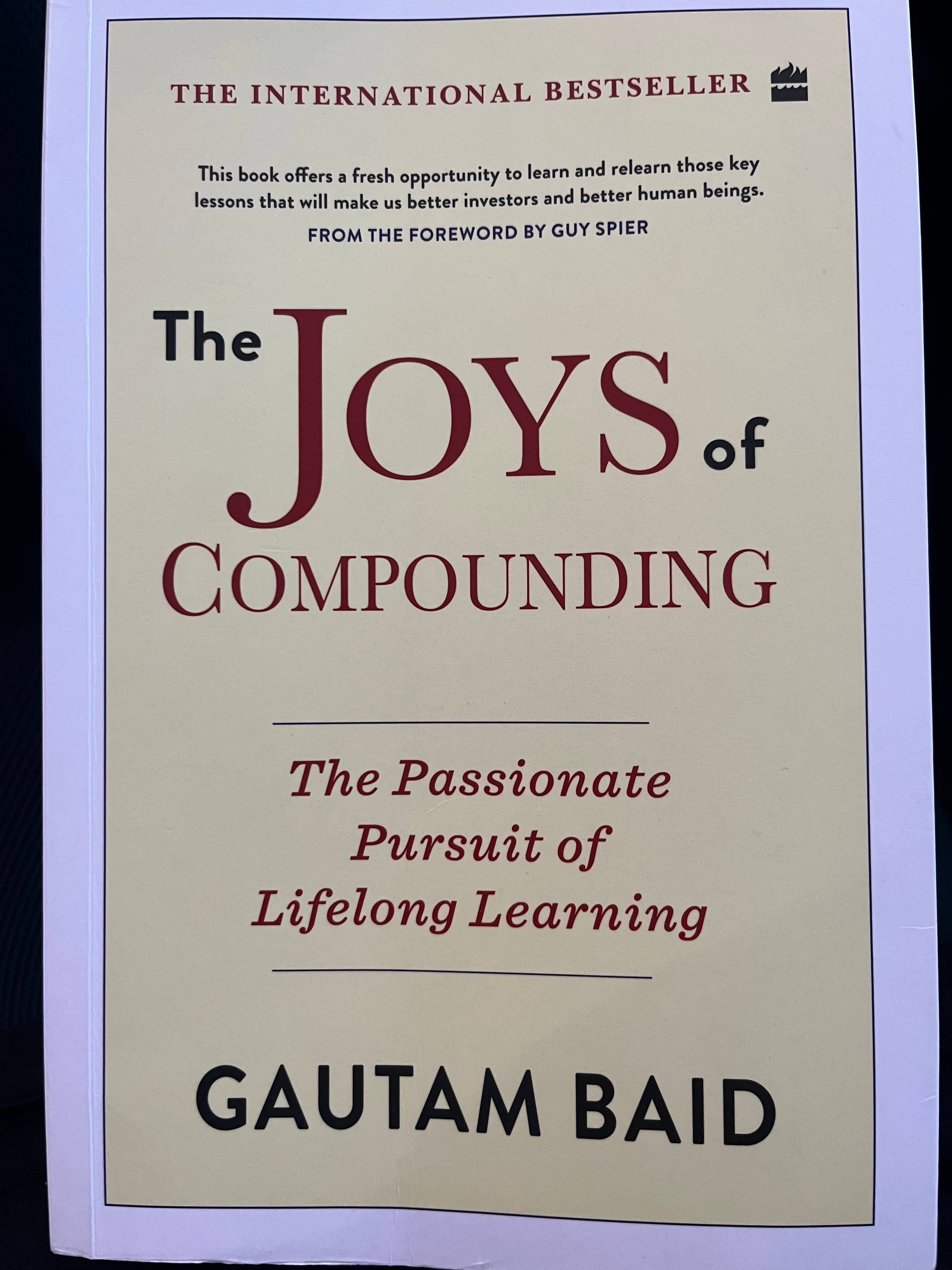
    When I read “The Joys of Compounding” by Gautam Baid, a few points in the first chapters of his book were quite powerful.

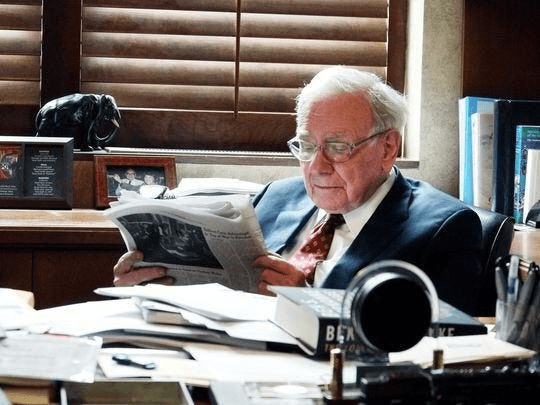
    As a young professional in Finance, I was initially struck that “Warren Buffet and Charlie Munger estimate that they spend 80 percent of their day reading or thinking about what they have read.”(9) As two well-known experts, the two ran Berkshire Hathaway. As thought-leaders in the industry, they are frequently relied on for investment direction.

    Warren Buffet pictured above reading (source)

    Baid introduced the idea to me, that reading is you investing in yourself and compounding your intelligence. I had never approached reading as a form of self-advancement like this before. Reading became an affordable way for me to learn opposed to going back to school formally. This mindset shift was powerful.

    Baid compared reading with investing:

    “the more you read, the more you build you mental repertoire. Incrementally, the knowledge you add to your stockpile will grow over time as it combines with everything new you put in there. This is compounding in action, and it works with knowledge in much the same way as it does with interest” (11).

    If you don’t consider yourself a reader, you can approach reading as an actionable way to invest in your own learning, and for all you know you might eventually grow into liking it. Reading exposes you to new subjects, storylines, vocabulary, lines of thinking, and language in general.

    Research has shown many other benefits. I highlighted three below that stuck out the most to me.

    Reading Improves Empathy

    Reading stories allows you to grow empathy, through experiencing the lives of others, feeling their emotions and being guided through their struggles and wins.

    Some research has drawn an association between reading fiction and tests of social acumen and empathy. In 2006, one study concluded that there was a correlation between the number of authors recognized and increased scores in empathy tests (Mar et. al). The research suggests that fiction may enhance the ability to understand other’s thoughts and feelings as well as provides a “simulation” of other social groups. Other research has explored this idea. It seems pretty obvious; when you learn of other people’s lives, struggles, thoughts, and emotions, you can empathize.

    When elementary and high school students in Italy and the UK read Harry Potter, one study found that they became more empathetic towards immigrants, refugees, and LGBTQ people (Vezzali et al). This was argued as being due to the exposure to social hierarchies and prejudice that can be seen in society.

    Reading Strengthens our Memory

    At a study done at University of Illinois, over an 8-week period, older adults had improvements in working memory (ability to hold things in our mind as we engage in mental processes) and episodic memory (long-term memory that involves recollection of previous experiences), due to regular, engaged reading (Lai 2023).

    Another study that echoes this, was a 14-year longitudinal study done with a representative sample of 1,962 Taiwanese individuals aged 64 and above. Those with higher reading frequencies (over once a week), were less likely to have cognitive decline at year 6, 10, and 14 (Chang et al).

    Reading can Act as a from of Stress Reduction

    In 2020, research done in Canada has shown that recreational reading was associated with reduced stress during a college school year (Levine et al.) Other studies had 24 adults participate in a stress-inducing task and then read for 60 minutes. They experienced a reduction in anxiety, heart rate, and blood pressure (Jin 1992).

    Whether a form of stress relief or as a form of advancement, reading can be beneficial for people who may struggle to focus and is good for our cognitive functioning. With technology discussed earlier, reading provides an unplugged outlet. Put on do not disturb and see how it impacts you.

    “I read to increase knowledge. I read to find meaning. I read for better understanding of others and myself. I read to discover. I read to make my life better. I read to make fewer mistakes.” (Baid 13)

    My Action Plan

    Jump forward a few months, I have been reading more and using my phone less (as much as possible but hey I never claimed to be perfect!) I found myself better able to focus and not reaching for my phone nearly as much.

    In 2025, I made the goal of reading one book per month. I am currently at 10 books for the year, with one month to go. To be honest, it will be tough to read two more in the short amount of time, but I am proud of my reading this year.

    Gautam Baid introduced how “the rich have money. The wealthy have control over their time. And time is the scarcest resource…Time is a universally depleting resource, reduced at the same rate for the wealthy as for the poor” (11). For some, reading is well within our means.

    *I also want to recognize that it is easier said than done. Reading for many is not within reach; work, kids, and other life responsibilities can prevent many from reading.*

    With that in mind, for those that might say “I have to find time,” I would respond one must make time.

    “If it matters to you, you will make time.”

    Nick Barre, CEO of Bare Performance Nutrition

    You might be asking yourself: what should I read?

    my recommendations

    To get into reading I had two things that really changed the game for me. The first was setting manageable daily goals. To form a habit, I think it is more important to build it into your daily routine and start small. I started with 10 pages everyday before bed. After I grew accustomed to that, I began to set a 20 minute timer to expand time spent reading. Soon it became second nature to read before bed.

    After creating this habit, I looked forward to going to bed and found myself reading more and more. Now I like to bring my book with me on my commute to work, often time choosing to read for the hour instead of scroll. What started as a forced task, has become an important part of my routine.

    Using apps like “Good Reads” or “Fable” can help you set goals! I personally like Fable. The app has fun visuals of the books you read over the year, describes you as a reader, and has social media type feed. You can read reviews and get book recommendations from others and create book clubs, building a sense of community. This further can provide a sense of social accountability, as you record what books you have read and when.

    My second recommendation is to try different books and genres. Find what keeps you reading, and lean into that genre! I like reading all different genres and authors, and I hope to expand to more.

    In the context of media and news, Guatam Baid claims that “the key lesson, in the pursuit of wisdom, we must read much more of what has endured over time (such as history or biographies) than what is ephemeral (such as daily news, social media trends, and the like)”(15). My personal reading goal is to read more classics and historical books in 2026. I want to gain knowledge that is timeless. For 2026, I have a goal of reading at least 15 books.

    some book recommendations to get started

    books that involve self improvement: Atomic Habits and The Joys of Compounding

    a captivating memoir: I’m Glad My Mom Died by Jennette McCurdy

    mystery/thriller: The Silent Patient by Alex Michaelides

    my book list from 2025

    1. The Joys of Compounding by Gautam Baid
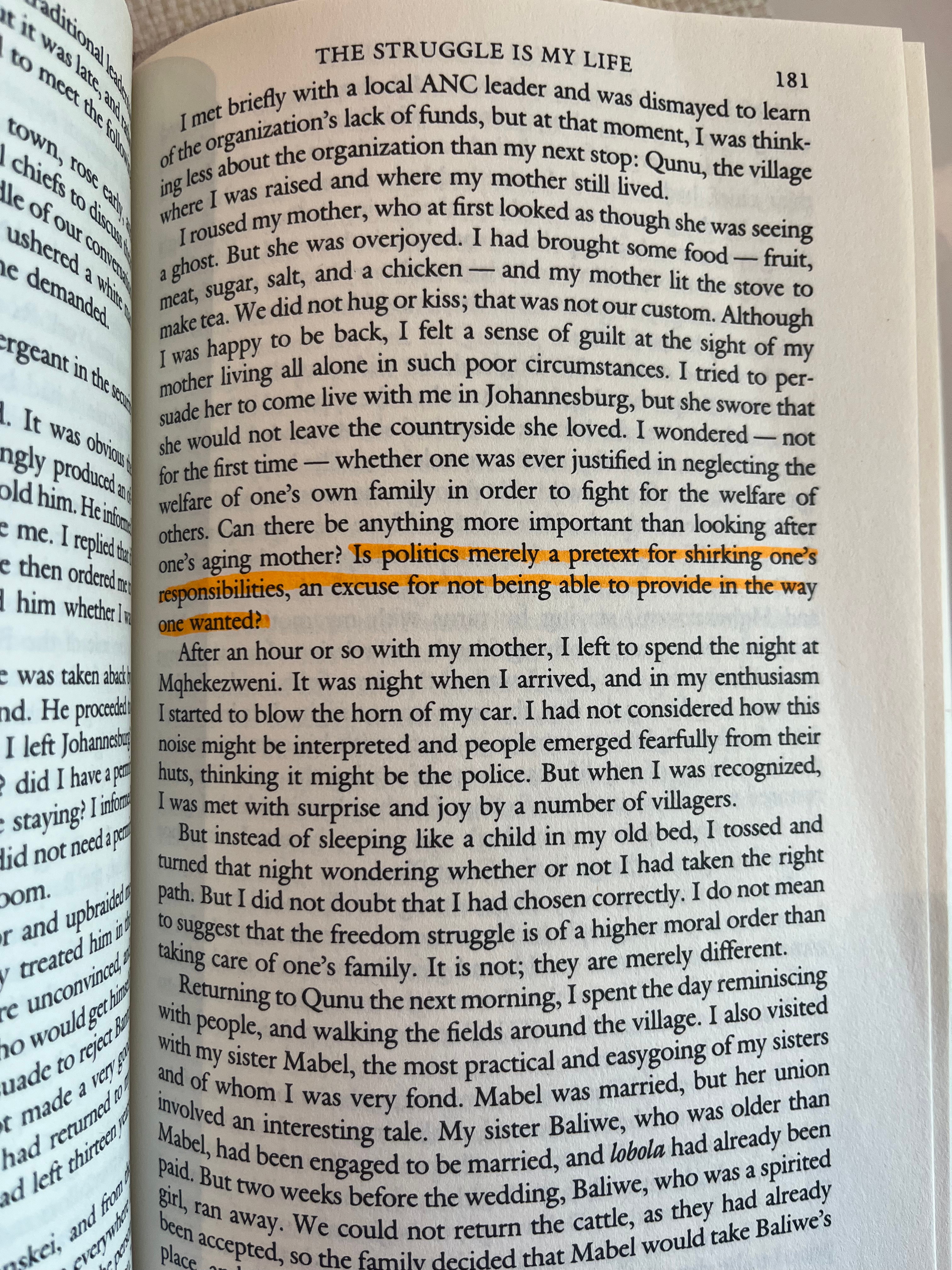
    2. Long Walk to Freedom by Nelson Mandela
    3. I’m Glad My Mom Died by Jennette McCurdy
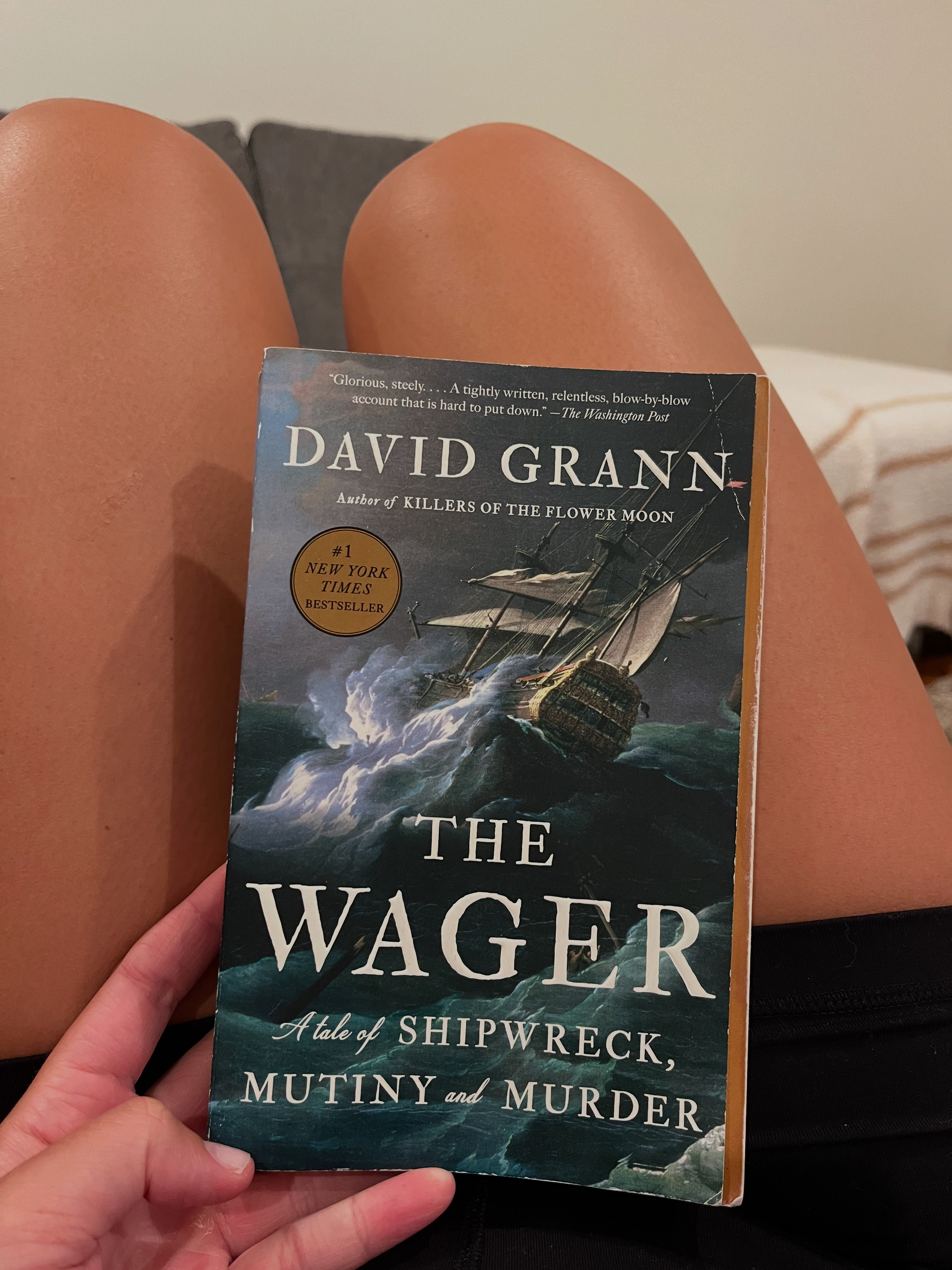
    4. The Wager David Grann
    5. Rich Dad Poor Dad by Robert T. Kiyosaki
    6. The Secret History by Donna Tartt
    7. It’s Trevor Noah: Born a Crime by Trevor Noah
    8. The Last Lecture by Randy Pausch, Jeffrey Zaslow
    9. Brutes by Dizz Tate
    10. The Economics of Public Issues by Roger LeRoy Miller

    works referenced

    Baid, G. (2023). The Joys of Compounding: The Passionate Pursuit of Lifelong Learning. Columbia Business School Publishing.

    Belkin, D. (2024, December 10). In a test of adult know-how, America comes up short. The Wall Street Journal. https://www.wsj.com/us-news/america-us-math-proficiency-falling-1b5ac73c

    Bone, J. K., Bu, F., Sonke, J. K., & Fancourt, D. (2025). The decline in reading for pleasure over 20 years of the American Time Use Survey. iScience, 28(9), Article 113288. https://doi.org/10.1016/j.isci.2025.113288

    Carrier, L. M., Rosen, L. D., & Rokkum, J. N. (2018, January 8). Productivity in peril: Higher and higher rates of technology multitasking. Behavioral Scientist. Retrieved from https://behavioralscientist.org/productivity-peril-higher-higher-rates-technology-multitasking/

    Chang, Y.-H., & Wu, I.-C., & Hsiung, C. A. (2021). Reading activity prevents long-term decline in cognitive function in older people: Evidence from a 14‑year longitudinal study. International Psychogeriatrics, 33(1), 63–74. https://doi.org/10.1017/S1041610220000812

    Great Hearts Academics. (2024, Oct 10). Sir Jonathan Bate Discusses the Loss of Literature in Schools on the BBC [Video]. YouTube.https://www.youtube.com/watch?v=f6UbKdAJytY .

    Griffey, H. (2018, October 14). The lost art of concentration: Being distracted in a digital world. The Guardian. https://www.theguardian.com/lifeandstyle/2018/oct/14/the-lost-art-of-concentration-being-distracted-in-a-digital-world

    Healthline. (2025, April 4). Benefits of reading books: How it can positively affect your life. Healthline. https://www.healthline.com/health/benefits-of-reading-books#increases-empathy

    James, W. (1890). The Principles of Psychology (Vol. 1, Ch. XI). Retrieved from https://psychclassics.yorku.ca/James/Principles/prin11.htm

    Jin P. Efficacy of Tai Chi, brisk walking, meditation, and reading in reducing mental and emotional stress. Journal of Psychosomatic Research. 1992 May; 36(4):361–370. PMID: 1593511.

    Lai, M. (2023, January 20). Research: Reading for pleasure can strengthen memory in older adults. Beckman Institute for Advanced Science and Technology. https://mcb.illinois.edu/news/2023-01-20/research-reading-pleasure-can-strengthen-memory-older-adults

    Levine, S. L., Cherrier, S., Holding, A. C., & Koestner, R. (2022). For the love of reading: Recreational reading reduces psychological distress in college students and autonomous motivation is the key. Journal of American College Health, 70(1), 158–164. https://doi.org/10.1080/07448481.2020.1728280

    Mar, R. A., Oatley, K., Hirsh, J., dela Paz, J., & Peterson, J. B. (2006). Bookworms versus nerds: Exposure to fiction versus non‑fiction, divergent associations with social ability, and the simulation of fictional social worlds. Journal of Research in Personality, 40(5), 694–712. https://doi.org/10.1016/j.jrp.2005.08.002

    Ofcom. (2018, August 2). The Communications Market 2018: Narrative report [PDF]. https://www.ofcom.org.uk/siteassets/resources/documents/research-and-data/cmr/cmr2018/cmr-2018-narrative-report.pdf?v=322208

    Thain, Maurion. (2024). Are young people’s attention spans really shrinking? It’s more complex than you might think. The Guardian. https://www.theguardian.com/commentisfree/2024/dec/26/young-people-attention-spans-online-world

    Vezzali, L., Stathi, S., Giovannini, D., Capozza, D., & Trifiletti, E. (2015). The greatest magic of Harry Potter: Reducing prejudice. Journal of Applied Social Psychology, 45(2), 105–121. https://doi.org/10.1111/jasp.12279

  • all opinions here are my own

    The Digital Age of Violence: Confronting Social Media’s Impact on the Self

    what to expect : why is social media creating violence and ways to work against the algorithms

    Social media is exacerbating divide. As companies aim to capture more attention by increasing the time users spend on their platforms, they simultaneously create addictive, destructive echo chambers.

    Social media algorithms are “technical means of sorting posts based on relevancy instead of publish time…[and they] can be written by coders who make use of machine learning”(Golinio 2021). Machine learning is exactly how it sounds: as machines perform tasks, they learn from the process and improve it. This means that as algorithms organize the content we see, they are continuously learning from and adapting based on how we interact with posts. While this personalizes our feeds to match our tastes and interests, it also increasingly leverages fear and heightened emotion to keep us scrolling.

    Research increasingly shows that we respond greater to negative news, a phenomenon called “negativity bias.” It is our biological nature to seek negative headlines and content, as neuroscientific research shows that when as we “encounter negative information, the amygdala sends signals that release vigilance and emotional arousal” (Ohman et al. 2001). This arousal and alertness can capture and hold attention. This incentivizes people to “doom-scroll,” seeking more and more content.

    On a similar vein, echo chambers are environments where people are surrounded by opinions and information that reinforce existing beliefs. Social media executives, in maximizing time spent on their platforms, are reducing exposure to conflicting ideas and show content similar to what users already engage in. By keeping people addicted to their social media, they inadvertently are isolating, polarizing, and radicalizing individuals. As a result, both the violence that has occurred and will likely continue, highlights the consequences of leaving social media companies largely unregulated.

    Scott Galloway in Prof G Markets podcast, “America’s New Age of Political Violence with Barbara F. Walter,” discussed social media in regards to Charlie Kirk’s assassination. Galloway is an NYU professor and media professional, and Barbara F. Walter is a professor at UC San Diego for the school of Global Policy and studies Political Violence.

    Scott and Barbara discuss the Facebook whistleblower, Frances Haugen. The former Facebook data scientist and product manager leaked thousands of documents to the SEC, that came to be known as the Facebook Papers. Barbara discussed the documents, and how the time spent on their platforms impacted violence, depression, anxiety, and other negative outcomes.

    The company’s research shows that it “amplified hate, misinformation, and political unrest” (Pelley, 2021). In Haugen’s experience, Facebook continuously had conflicts of interest between what was good for the public versus what was good for Facebook. In her eyes, they optimized their own interests and profits.


    From Facebook “we have evidence from a variety of sources that hate speech, divisive political speech, and misinformation on Facebook and the family of apps are affecting societies around the world”

    From the Facebook Papers, Pelley 2021

    Algorithms prioritize engagement over well-being, causing the use of polarizing and inflammatory content.

    In 2023, Meta was sued for misleading the public about safety and harming the mental health of children by 33 states (Sy and Dubnow, 2023). One PBS interview with WSJ writer, Jeff Horwitz, discussed the harm that is caused by social media platforms. He created test accounts, and found that as soon as you start following slightly suspect entities the algorithm will start pushing hard into increasingly dark content, including things like kidnapping children being a subject group (3:00-3:32).

    The company is working to “clean the system up,” according to Horwitz, however it is still a pervasive and far-reaching issue. Regulations and steps to prevent this, are at odds with their priority of privacy and freedom of speech.

    After Charlie Kirk’s death Utah Governer Spencer Cox referred to social media companies as “conflict entrepreneurs”. On NBC news, Cox said  “I believe social media has played a direct role in every single assassination and assassination attempts we’ve seen over the last five, six years…What we have done to our kids. It has taken us a decade to understand how evil these algorithms are.” People are addicted to outrage in Cox’s words, “which is the same type of dopamine, the same chemical you get from taking fentanyl and get us to hate each other.” The evolving landscape in politics has created extreme divide, with “us” versus “them” content.

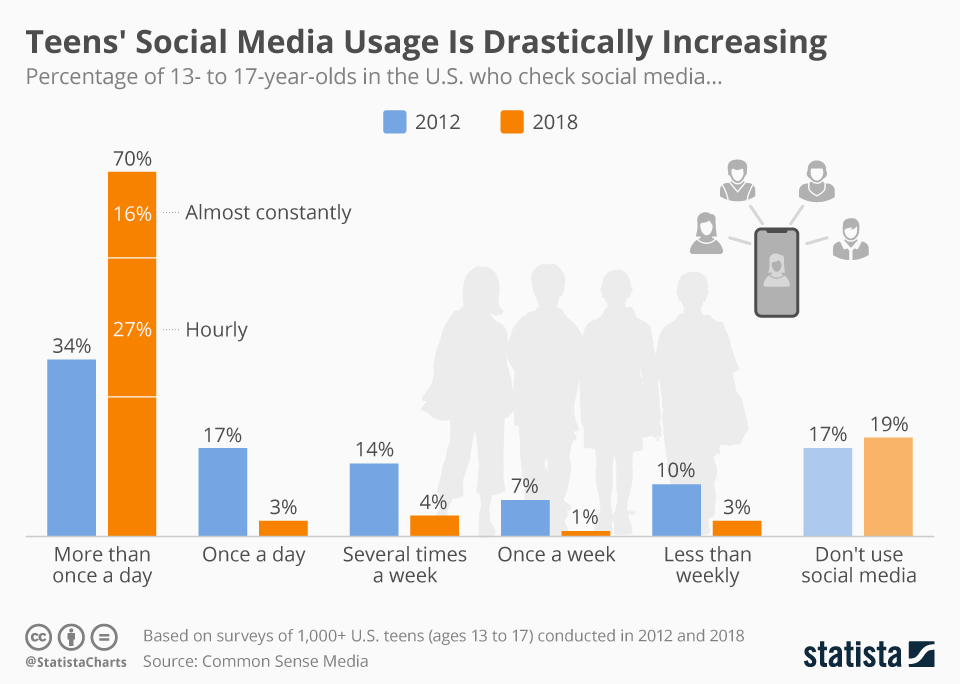
    Social media does not just have negative outcomes in regard to political acts of violence. In 2021, the Wall Street Journal published the Facebook Papers, showing that Instagram was making body image issues worse in one in three teenage girls. (Wells et al 2021). One study, done by Federica Pedalino and Anne-Linda Camerini, in the International Journal of Environmental Research and Public Health, concluded that browsing on Instagram was associated with lower levels of body appreciation, increased social comparison with influencers, and highlighted the need for public health interventions (2022).

    chart source

    The Business Incentives

    In their quarter three earnings, Meta reported $51.24 billion, showing around 26% year-over-year (YoY) growth. For a company of this size and maturity, this growth is astonishing.

    Engagement on their platforms shows daily active users, across the family of apps, at 3.54 billion, up 8% YoY. As active users increase, so does their profit. The more time spent on their platforms, the more ads users see. In Q3, ad impressions increased 14% YoY. With meta’s revenue almost entirely from ad revenue, they are incentivized to maximize spend on their apps.

    In Meta’s earnings Q3 Earnings call, CEO Mark Zuckerberg discussed that they are actively increasing the time spent on their apps, with Facebook, Threads, and Video being up 5%, 10%, and more than 30% respectively. As video grows, Instagram Reels has an “annual run rate of over $50 billion” (Earnings Call).

    Social media companies face a tradeoff between maximizing profit through user engagement and safeguarding the well-being of users and society. The growth and efficiency of this business model comes at the expense of the public good. As artificial intelligence improves, we can only assume that these problems will increase.

    Regulatory oversight of Meta and the broader social media industry has to adjust to the changing landscape. This includes addressing both direct issues, like lenient ad moderation1, and indirect affects, such as the creation of emotionally charged, fear-inducing user experiences.

    what can we do? from awareness to action

    Social media offers significant benefits to both people and businesses, and frankly, it’s not going anywhere.

    Naturally, one would suggest deleting social media as the most direct solution. However, I am not going to sit here and say to delete all social media.

    Social media still brings a lot of good. It raises awareness of important issues and facilitates collective action. It promotes transparency and accountability, helps communities grow, and spreads knowledge at unprecedented rates. The real challenge lies in learning to use it intentionally and thoughtfully.

    In my own experience, my algorithm has made me “hooked” at many times, and 100% has capitalized on what makes my emotions heightened. For example, I respond very well to “hopecore,” essentially feel-good videos like military homecomings, gifting a dog, or surprising a loved one. I too have felt the sense of “doom” that social media perpetuates. But I have been taking an active role against it, and want to help others to do the same.

    To start, I want to remind anyone reading this, that the digital world, is not real. Yes, you talk to real people and interact with real things, but I want to remind you that this is a constructed environment. People portray a snippet of their life, carefully curated and constructed. Try not to equate online interactions to genuine human connections and experiences.

    1. create more than you consume

    I want to start with a mindset shift of consumption in general. Consumption is usually thought of as what we are eating or what we buy. But we are affected by all consumption. What movies we watch, books we read, people we spend time with, and social media accounts we follow. Take inventory of what you are consuming, and be mindful of that consumption. We are not made to spend everyday going from little screen, to medium screen, to big screen.

    Try more hobbies. Physical hobbies. Painting, walking, reading, you get the point. I made a list of things that you can do instead of scroll:

    • buy a puzzle
    • create and plan a friends night
    • try a new restaurant
    • deep clean your space
    • bake something
    • make a vision board
    • write something
    • take cute pictures of a city or town you live in
    • find new music
    • do a 15 minute yoga video

    also, you can create in the digital world! write a blog like this, make a youtube video, whatever you want! just try to balance the creation with consumption

    2. take digital breaks, and encourage those around you to do it to

    Do anything that “adds a step” to opening your phone, or acts as a barrier to entry. From Atomic Habits, written by James Clear, when a habit is harder to start, the likelihood of doing it drops sharply. This is the principle of “friction,” the more friction added, the less-likely a behavior will occur. Some ways of adding friction to reaching for your phone: putting your phone in another room when working, turning off notifications, or deleting the apps Mon-Fri. If you set a limit on social media use per day, it pauses mindless scrolling to remind you that time is up. Mine is set for an hour, and that notification alone prevents me from scrolling.

    While taking these measures, normalize talking to your friends about this. Talk to your friends and family about social media. This is a collective struggle and problem, and the most people around you that are conscious of it, the more you can mutually grow.

    3. reflect more: journal daily

    Reflection is the first step towards growth. Journal and check-in with yourself frequently. Especially try to reflect after a doom-scroll. Do you feel uplifted? Do you feel anxious? Do you suddenly feel like you need more material things? (a common feeling social media gives me).

    Some journaling prompts I love :

    what is bringing joy to my life right now?

    what is taking away?

    where are ways that I want to grow?

    how do I want to spend my time?

    I can almost assure you that aside from content creation, these answers won’t be related to social media. I at least don’t want to grow through continuous comparison and doom scrolling.

    4. if you scroll, scroll with intention

    All of this to say, you can also take back control of your scrolling. While algorithms are created for us, we decide what we interact with, who we follow, what we send to friends, what we like, etc. Be conscious of who and what you follow, always.

    thanks for reading ❤

    some ways i have recently unplugged

    works referenced:

    Cox, S. (2025, September 14). Utah Gov. Spencer Cox calls social media companies ‘conflict entrepreneurs’ that share blame for Charlie Kirk’s death. Business  Insider. Retrieved from https://www.businessinsider.com/charlie‐kirk‐death‑social‑media‑role‐utah‑governor‑spencer‑cox‑2025‑9

    Golino, M. A. (2021, April 24). Algorithms in social media platforms: How social media algorithms influence the spread of culture and information in the digital society. Institute for Internet and the Just Society. https://www.internetjustsociety.org/algorithms-in-social-media-platforms

    Horwitz, J. (2025, November 6). Meta is earning a fortune on a deluge of fraudulent ads, documents show. Reuters. https://www.reuters.com/investigations/meta-is-earning-fortune-deluge-fraudulent-ads-documents-show-2025-11-06/

    Marano, H. E. (2003, June 20). Our brain’s negative bias: Why our brains are more highly attuned to negative news. Psychology Today. https://www.psychologytoday.com/us/articles/200306/our-brains-negative-bias

    Meta Platforms, Inc. (2025, October 29). Meta Reports Third Quarter 2025 Results. https://investor.atmeta.com/investor-news/press-release-details/2025/Meta-Reports-Third-Quarter-2025-Results/default.aspx?utm_source=chatgpt.com

    Meta Platforms, Inc. (2025, October 29). Third quarter 2025 results conference call transcript [Transcript]. https://s21.q4cdn.com/399680738/files/doc_financials/2025/q3/META-Q3-2025-Earnings-Call-Transcript.pdf

    Ohman, A., Flykt, A., & Esteves, F. (2001). Emotion drives attention: Detecting the snake in the grass. Journal of Experimental Psychology: General, 130(3), 466–478. https://doi.org/10.1037/0096-3445.130.3.466

    Riva, G., Monti, R. P., Bassi, M., Bianchi, D., Franchin, L., & Monaro, M. (2022). Instagram use and body dissatisfaction: The mediating role of upward social comparison with peers and influencers among young females. International Journal of Environmental Research and Public Health, 19(3), 1543. https://doi.org/10.3390/ijerph19031543

    Wells G., Horwitz J., Seetharaman D. The Facebook Files. Wall Street Journal. Sep 14, 2021.

    Sy, S., & Dubnow, S. (2023, December 26). States suing Meta accuse company of manipulating its apps to make children addicted. PBS NewsHour. https://www.pbs.org/newshour/show/states-suing-meta-accuse-company-of-manipulating-its-apps-to-make-children-addicted

    1. The lack of regulatory oversight over the social media business is further seen in advertising. Meta earns about $7 billion in annualized revenue from scam advertisements (Horwitz 2025). Meta accepts revenue from sources expected of fraud, showing a “lack of regulatory oversight of the advertising industry,” one fraud examiner, Sandeep Abraham said. ↩︎

    0

    Comments

    Leave a comment

  • all opinions here are my own

    The Start of M-FOUR

    Hi, I’m Megan! I just entered the work force this past July after finishing college. At 22, I have a lot to learn, and I wanted a space to put it all down. Stepping into full-time work made me realize how important it is to keep creating and learning in new areas. This will be a space for all my passion projects and reflections, across the four spaces I love most: markets and investing, movement and lifting, mental health and well-being, and personal finance. Follow along as I learn, grow, and share.

    The Four Ms

    Mind

    Mental and spiritual health has always been a focus in my adult life. The established pillars that I prioritize first are movement, social connectivity, nutrition, and sleep. This space is dedicated to exploring habits, routines, personal reflection, and overall mental well-being.

    Markets and Money

    Money and commerce are a force that drive us, shaping both what we value and how deeply we value it. What we exchange to improve our lives, is impacted by the markets and our use of money. Whether buying your first home, finding a job, or investing for retirement, we all depend on the market. This portion of the blog is centered on the understanding of our financial systems and news (markets), and then our personal decisions (money).

    How we interact and make decisions is a lifelong learning that I am far from completing. In my opinion we never get it necessarily right, we just get it less and less wrong.

    Movement

    My love for movement started with strength training back in high school. Over time, it has grown into something much broader, from rock climbing with friends to hiking in a new place. Movement is important for my daily routine, as a way to a manage stress and a key to my long-term health. I will use this space to talk about progress, setbacks, and rewards that come from an active lifestyle.