
what to expect : why is social media creating violence and ways to work against the algorithms
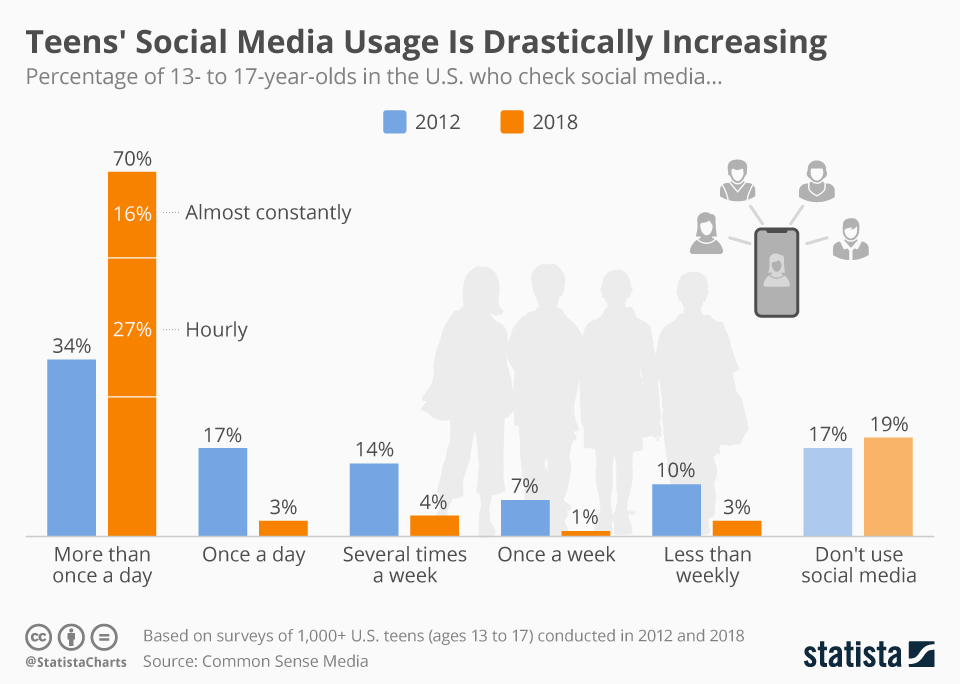
Social media is exacerbating divide. As companies aim to capture more attention by increasing the time users spend on their platforms, they simultaneously create addictive, destructive echo chambers.
Social media algorithms are “technical means of sorting posts based on relevancy instead of publish time…[and they] can be written by coders who make use of machine learning”(Golinio 2021). Machine learning is exactly how it sounds: as machines perform tasks, they learn from the process and improve it. This means that as algorithms organize the content we see, they are continuously learning from and adapting based on how we interact with posts. While this personalizes our feeds to match our tastes and interests, it also increasingly leverages fear and heightened emotion to keep us scrolling.
Research increasingly shows that we respond greater to negative news, a phenomenon called “negativity bias.” It is our biological nature to seek negative headlines and content, as neuroscientific research shows that when as we “encounter negative information, the amygdala sends signals that release vigilance and emotional arousal” (Ohman et al. 2001). This arousal and alertness can capture and hold attention. This incentivizes people to “doom-scroll,” seeking more and more content.
On a similar vein, echo chambers are environments where people are surrounded by opinions and information that reinforce existing beliefs. Social media executives, in maximizing time spent on their platforms, are reducing exposure to conflicting ideas and show content similar to what users already engage in. By keeping people addicted to their social media, they inadvertently are isolating, polarizing, and radicalizing individuals. As a result, both the violence that has occurred and will likely continue, highlights the consequences of leaving social media companies largely unregulated.
Scott Galloway in Prof G Markets podcast, “America’s New Age of Political Violence with Barbara F. Walter,” discussed social media in regards to Charlie Kirk’s assassination. Galloway is an NYU professor and media professional, and Barbara F. Walter is a professor at UC San Diego for the school of Global Policy and studies Political Violence.
Scott and Barbara discuss the Facebook whistleblower, Frances Haugen. The former Facebook data scientist and product manager leaked thousands of documents to the SEC, that came to be known as the Facebook Papers. Barbara discussed the documents, and how the time spent on their platforms impacted violence, depression, anxiety, and other negative outcomes.
The company’s research shows that it “amplified hate, misinformation, and political unrest” (Pelley, 2021). In Haugen’s experience, Facebook continuously had conflicts of interest between what was good for the public versus what was good for Facebook. In her eyes, they optimized their own interests and profits.
From the Facebook Papers, Pelley 2021
From Facebook “we have evidence from a variety of sources that hate speech, divisive political speech, and misinformation on Facebook and the family of apps are affecting societies around the world”
Algorithms prioritize engagement over well-being, causing the use of polarizing and inflammatory content.
In 2023, Meta was sued for misleading the public about safety and harming the mental health of children by 33 states (Sy and Dubnow, 2023). One PBS interview with WSJ writer, Jeff Horwitz, discussed the harm that is caused by social media platforms. He created test accounts, and found that as soon as you start following slightly suspect entities the algorithm will start pushing hard into increasingly dark content, including things like kidnapping children being a subject group (3:00-3:32).
The company is working to “clean the system up,” according to Horwitz, however it is still a pervasive and far-reaching issue. Regulations and steps to prevent this, are at odds with their priority of privacy and freedom of speech.
After Charlie Kirk’s death Utah Governer Spencer Cox referred to social media companies as “conflict entrepreneurs”. On NBC news, Cox said “I believe social media has played a direct role in every single assassination and assassination attempts we’ve seen over the last five, six years…What we have done to our kids. It has taken us a decade to understand how evil these algorithms are.” People are addicted to outrage in Cox’s words, “which is the same type of dopamine, the same chemical you get from taking fentanyl and get us to hate each other.” The evolving landscape in politics has created extreme divide, with “us” versus “them” content.
Social media does not just have negative outcomes in regard to political acts of violence. In 2021, the Wall Street Journal published the Facebook Papers, showing that Instagram was making body image issues worse in one in three teenage girls. (Wells et al 2021). One study, done by Federica Pedalino and Anne-Linda Camerini, in the International Journal of Environmental Research and Public Health, concluded that browsing on Instagram was associated with lower levels of body appreciation, increased social comparison with influencers, and highlighted the need for public health interventions (2022).
The Business Incentives
In their quarter three earnings, Meta reported $51.24 billion, showing around 26% year-over-year (YoY) growth. For a company of this size and maturity, this growth is astonishing.
Engagement on their platforms shows daily active users, across the family of apps, at 3.54 billion, up 8% YoY. As active users increase, so does their profit. The more time spent on their platforms, the more ads users see. In Q3, ad impressions increased 14% YoY. With meta’s revenue almost entirely from ad revenue, they are incentivized to maximize spend on their apps.
In Meta’s earnings Q3 Earnings call, CEO Mark Zuckerberg discussed that they are actively increasing the time spent on their apps, with Facebook, Threads, and Video being up 5%, 10%, and more than 30% respectively. As video grows, Instagram Reels has an “annual run rate of over $50 billion” (Earnings Call).
Social media companies face a tradeoff between maximizing profit through user engagement and safeguarding the well-being of users and society. The growth and efficiency of this business model comes at the expense of the public good. As artificial intelligence improves, we can only assume that these problems will increase.
Regulatory oversight of Meta and the broader social media industry has to adjust to the changing landscape. This includes addressing both direct issues, like lenient ad moderation1, and indirect affects, such as the creation of emotionally charged, fear-inducing user experiences.
what can we do? from awareness to action
Social media offers significant benefits to both people and businesses, and frankly, it’s not going anywhere.
Naturally, one would suggest deleting social media as the most direct solution. However, I am not going to sit here and say to delete all social media.
Social media still brings a lot of good. It raises awareness of important issues and facilitates collective action. It promotes transparency and accountability, helps communities grow, and spreads knowledge at unprecedented rates. The real challenge lies in learning to use it intentionally and thoughtfully.
In my own experience, my algorithm has made me “hooked” at many times, and 100% has capitalized on what makes my emotions heightened. For example, I respond very well to “hopecore,” essentially feel-good videos like military homecomings, gifting a dog, or surprising a loved one. I too have felt the sense of “doom” that social media perpetuates. But I have been taking an active role against it, and want to help others to do the same.
To start, I want to remind anyone reading this, that the digital world, is not real. Yes, you talk to real people and interact with real things, but I want to remind you that this is a constructed environment. People portray a snippet of their life, carefully curated and constructed. Try not to equate online interactions to genuine human connections and experiences.
1. create more than you consume
I want to start with a mindset shift of consumption in general. Consumption is usually thought of as what we are eating or what we buy. But we are affected by all consumption. What movies we watch, books we read, people we spend time with, and social media accounts we follow. Take inventory of what you are consuming, and be mindful of that consumption. We are not made to spend everyday going from little screen, to medium screen, to big screen.
Try more hobbies. Physical hobbies. Painting, walking, reading, you get the point. I made a list of things that you can do instead of scroll:
- buy a puzzle
- create and plan a friends night
- try a new restaurant
- deep clean your space
- bake something
- make a vision board
- write something
- take cute pictures of a city or town you live in
- find new music
- do a 15 minute yoga video
also, you can create in the digital world! write a blog like this, make a youtube video, whatever you want! just try to balance the creation with consumption
2. take digital breaks, and encourage those around you to do it to
Do anything that “adds a step” to opening your phone, or acts as a barrier to entry. From Atomic Habits, written by James Clear, when a habit is harder to start, the likelihood of doing it drops sharply. This is the principle of “friction,” the more friction added, the less-likely a behavior will occur. Some ways of adding friction to reaching for your phone: putting your phone in another room when working, turning off notifications, or deleting the apps Mon-Fri. If you set a limit on social media use per day, it pauses mindless scrolling to remind you that time is up. Mine is set for an hour, and that notification alone prevents me from scrolling.
While taking these measures, normalize talking to your friends about this. Talk to your friends and family about social media. This is a collective struggle and problem, and the most people around you that are conscious of it, the more you can mutually grow.
3. reflect more: journal daily
Reflection is the first step towards growth. Journal and check-in with yourself frequently. Especially try to reflect after a doom-scroll. Do you feel uplifted? Do you feel anxious? Do you suddenly feel like you need more material things? (a common feeling social media gives me).
Some journaling prompts I love :
what is bringing joy to my life right now?
what is taking away?
where are ways that I want to grow?
how do I want to spend my time?
I can almost assure you that aside from content creation, these answers won’t be related to social media. I at least don’t want to grow through continuous comparison and doom scrolling.
4. if you scroll, scroll with intention
All of this to say, you can also take back control of your scrolling. While algorithms are created for us, we decide what we interact with, who we follow, what we send to friends, what we like, etc. Be conscious of who and what you follow, always.
thanks for reading ❤



works referenced:
Cox, S. (2025, September 14). Utah Gov. Spencer Cox calls social media companies ‘conflict entrepreneurs’ that share blame for Charlie Kirk’s death. Business Insider. Retrieved from https://www.businessinsider.com/charlie‐kirk‐death‑social‑media‑role‐utah‑governor‑spencer‑cox‑2025‑9
Golino, M. A. (2021, April 24). Algorithms in social media platforms: How social media algorithms influence the spread of culture and information in the digital society. Institute for Internet and the Just Society. https://www.internetjustsociety.org/algorithms-in-social-media-platforms
Horwitz, J. (2025, November 6). Meta is earning a fortune on a deluge of fraudulent ads, documents show. Reuters. https://www.reuters.com/investigations/meta-is-earning-fortune-deluge-fraudulent-ads-documents-show-2025-11-06/
Marano, H. E. (2003, June 20). Our brain’s negative bias: Why our brains are more highly attuned to negative news. Psychology Today. https://www.psychologytoday.com/us/articles/200306/our-brains-negative-bias
Meta Platforms, Inc. (2025, October 29). Meta Reports Third Quarter 2025 Results. https://investor.atmeta.com/investor-news/press-release-details/2025/Meta-Reports-Third-Quarter-2025-Results/default.aspx?utm_source=chatgpt.com
Meta Platforms, Inc. (2025, October 29). Third quarter 2025 results conference call transcript [Transcript]. https://s21.q4cdn.com/399680738/files/doc_financials/2025/q3/META-Q3-2025-Earnings-Call-Transcript.pdf
Ohman, A., Flykt, A., & Esteves, F. (2001). Emotion drives attention: Detecting the snake in the grass. Journal of Experimental Psychology: General, 130(3), 466–478. https://doi.org/10.1037/0096-3445.130.3.466
Riva, G., Monti, R. P., Bassi, M., Bianchi, D., Franchin, L., & Monaro, M. (2022). Instagram use and body dissatisfaction: The mediating role of upward social comparison with peers and influencers among young females. International Journal of Environmental Research and Public Health, 19(3), 1543. https://doi.org/10.3390/ijerph19031543
Wells G., Horwitz J., Seetharaman D. The Facebook Files. Wall Street Journal. Sep 14, 2021.
Sy, S., & Dubnow, S. (2023, December 26). States suing Meta accuse company of manipulating its apps to make children addicted. PBS NewsHour. https://www.pbs.org/newshour/show/states-suing-meta-accuse-company-of-manipulating-its-apps-to-make-children-addicted
- The lack of regulatory oversight over the social media business is further seen in advertising. Meta earns about $7 billion in annualized revenue from scam advertisements (Horwitz 2025). Meta accepts revenue from sources expected of fraud, showing a “lack of regulatory oversight of the advertising industry,” one fraud examiner, Sandeep Abraham said. ↩︎

